How to Make a Storyboard: One Script Scene in Six Shots
A storyboard comes from the order of decisions, not drawing skill. Follow along as a short scene of two people meeting again in a café is split into six shots.
The script we start from
A rainy evening, the alley in front of a small café. Jisu walks along the wet alley toward the café.
In the café by the window, Minho, who was reading, looks up at the sound of a bell.
Jisu: …Minho?
Minho: Long time no see. Want to sit here?
Two people sitting across from each other. The rain stops.
1. Write what the scene does in one line
Before splitting the scene into shots, write down what should be different when it ends. Here: “someone who was walking alone ends up sitting across from someone.” Any shot unrelated to this line is the first to cut later.
2. Draw a line wherever something changes
Read the script and draw a line wherever the place, the point of view or the emotion changes. Each stretch between lines is one shot.
- Location changes From the alley to inside the café (between shots 1 and 2)
- Viewpoint changes Minho looks up, and we cut to Jisu’s face (between shots 2 and 3)
- Emotion shifts From surprise to delight (between shots 3 and 4, and between 4 and 5)
- Scene closes The camera pulls away from the two of them (between shots 5 and 6)
3. Pick a shot size and angle for each shot
Give each shot just one thing the audience needs to know. Then size and angle almost choose themselves.
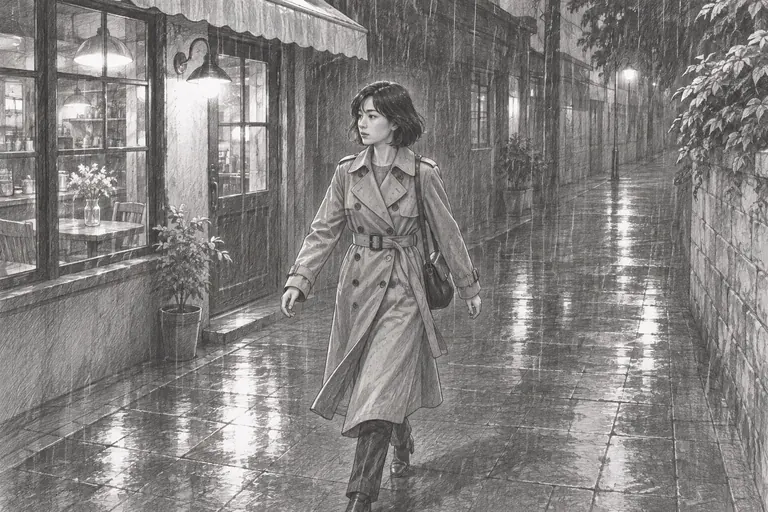 Long shot · Eye level · 35mm
Tells the viewer both that it’s a rainy evening and that Jisu is walking alone.
 Medium shot · Eye level · 50mm
The motion of looking up needs to show, so frame from the waist up.
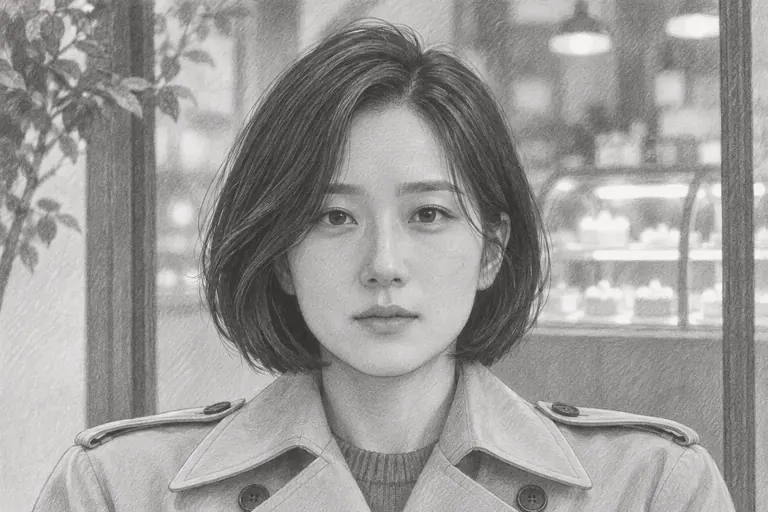 Close-up · Eye level · 85mm
The moment of recognition is the face. Use a long lens to compress the background and focus on the face.
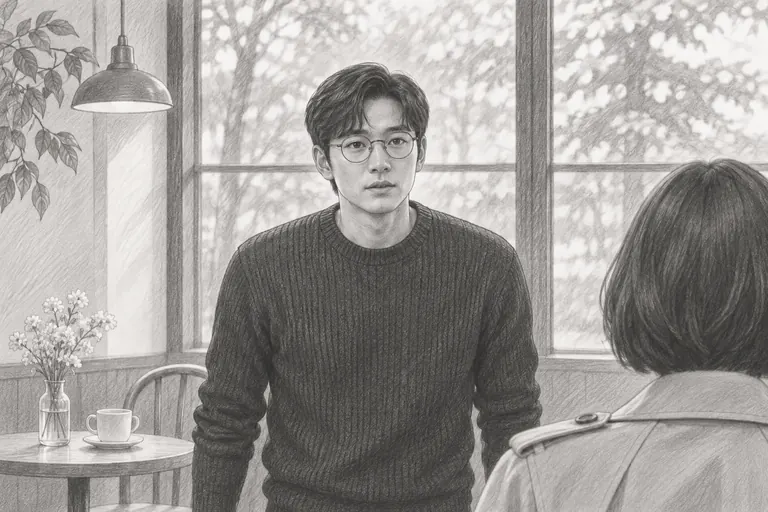 Over-the-shoulder medium shot · 85mm
Over Jisu’s shoulder, showing that the two are in the same space.
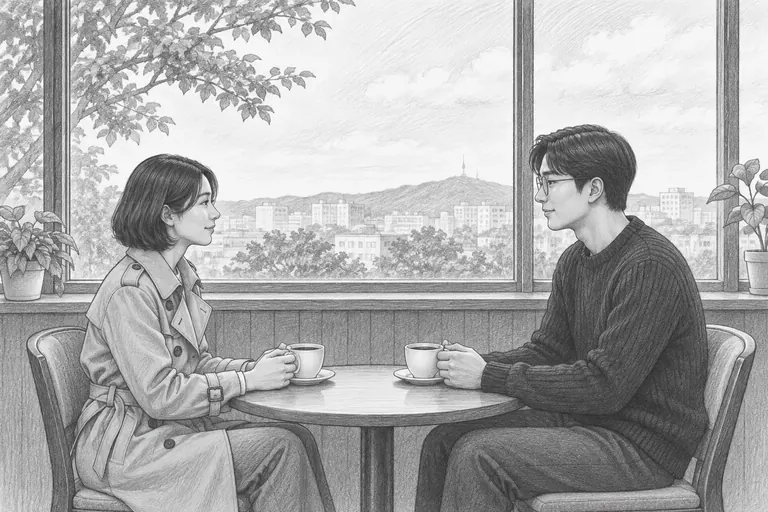 Medium long two-shot · 35mm
The distance between them, and the table, show how they relate.
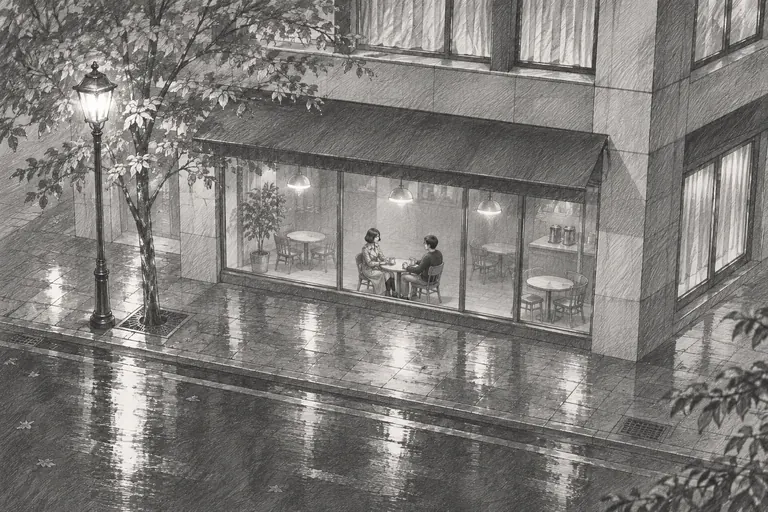 Extreme long shot · High angle · 35mm
Pulls back to a high spot across the street to close the scene.
All six images are example storyboard frames drawn by AI with the 3D blocking as reference. Compare shot sizes and angles in 3D
4. Match eyelines and direction
Draw one line between the two people talking and keep the camera on one side of it. Cross it and they look like they face the same direction. If Jisu looks to the right of the frame in the two-shot of shot 5, frame the solo shot of Jisu that follows looking right too.
5. Add dialogue, sound and timing
Read the dialogue aloud and time it in seconds. For shots with no dialogue, act out the movement and time that. In the example the shots run 3, 3, 2, 3, 4 and 3 seconds, 18 seconds in all.
6. Play it through from the start
- Does the story still work when you flip through the images alone?
- Are two consecutive shots too similar?
- Is there a shot left that doesn’t serve the one-line summary of the scene?
- Does the total time fit the target length?
Open these six shots yourself
An example storyboard that holds the shots from this article exactly. You can move the camera and characters without signing in.